Practical skills
Circuit-testing sims
Safe isolation and testing on a virtual kitchen radial, with a real consumer unit and tester.
Who it’s for
Anyone who wants to practise safe isolation and testing before doing it for real.
What’s inside
- Learn mode guides you step by step
- Practice mode checks your readings as you go
- Assessment mode is timed and marked, with Pass, Merit and Distinction
Why it helps
Make your mistakes on screen, not on a live board. More sims are on the way.
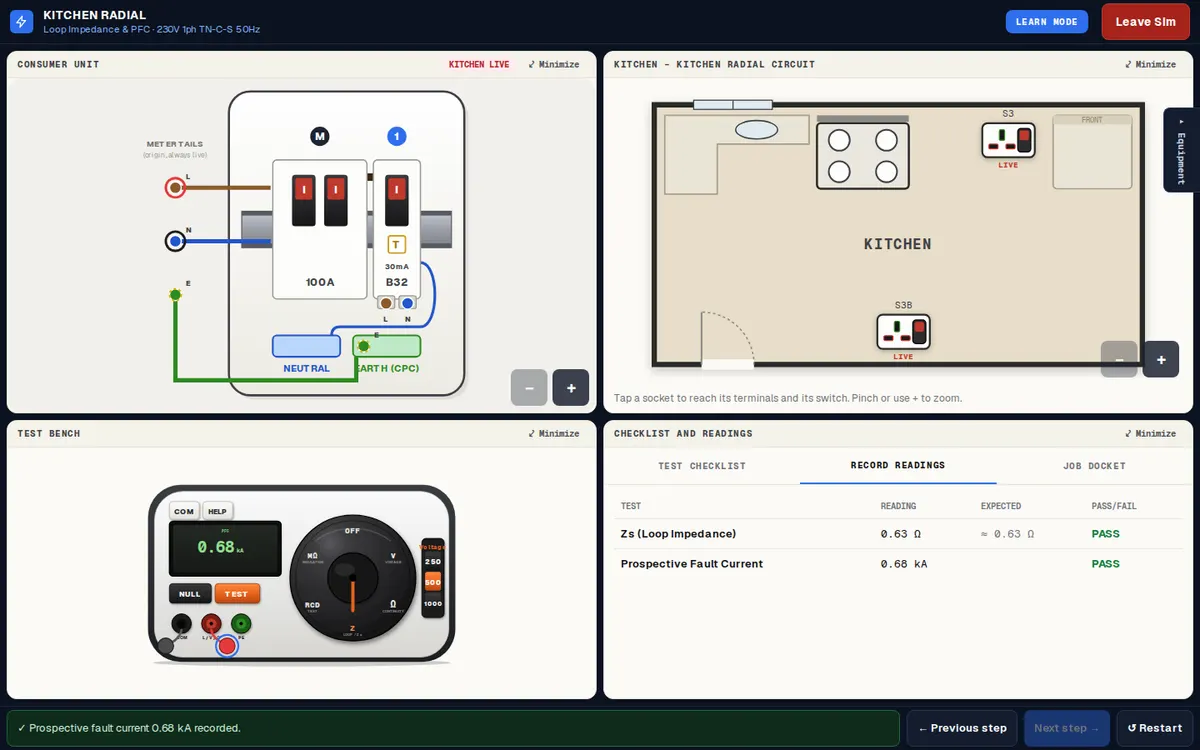
Safe isolation and testing are skills you learn by doing, but nobody wants an apprentice's first mistake to be on a live board. The circuit-testing sims let you practise on screen first.
The first sim is a kitchen radial on its own RCBO. You take out your tester, voltage indicator and proving unit, isolate and lock off safely, then carry out the tests and write down your readings. Learn mode guides you step by step, Practice mode checks your readings as you go, and Assessment mode is timed and marked, with Pass, Merit and Distinction. Guided walk-throughs show every move.
Every reading the sim gives comes from the circuit itself: the cable size, the cable length and the protective device, worked out the same way you'd work them out on paper. That means the numbers make sense, and you learn what a good reading looks like for that circuit, not just which buttons to press.
What you practise
Test 1
Safe Isolation
Test 2
Continuity Testing
Test 3
Insulation Resistance
Test 4
Polarity Check
Test 5
Loop Impedance & PFC
Test 6
RCD Test
Test 7
Fault Finding
How to use it
- 1Take the screen tour to learn where everything is: the consumer unit, the room, the tester and the checklist.
- 2Follow the guided walk-through for a test. It rings each thing to tap and explains why each step matters.
- 3Try the same test in Learn mode, then in Practice mode, where you type in your own readings.
- 4When you're confident, sit the Assessment: it's timed, marked on the server, and graded Pass, Merit or Distinction.
Try a sample question
When proving a circuit dead with an approved voltage indicator, the correct procedure is to:
- ATest the circuit first, then prove the voltage indicator on a known live source
- BProve the indicator on a known source, test the circuit, then prove the indicator again
- CTest only between the line and neutral conductors at the socket
- DIsolate the supply at the board and then assume the circuit is dead
Show the answer
Answer: B. Safe isolation follows prove-test-prove: prove the voltage indicator on a known source or proving unit, test all conductor combinations of the isolated circuit, then prove the indicator again to confirm the indicator did not fail during the test.
Try it free, no sign-in
Questions about this course
- Can the sims replace practical training?
- No. The sims help you learn the order and the reasons, so you're confident before you do it for real under supervision. They never replace practical training or assessment.
- What happens if I make a dangerous mistake?
- In Learn and Practice mode, the sim stops you and explains what went wrong. In Assessment mode, a dangerous mistake, such as touching a live terminal with a probe, is an automatic fail, as it would be in a real assessment.
- Which tests does the Kitchen radial cover?
- Safe isolation, continuity of the protective conductors, insulation resistance, polarity, earth fault loop impedance (Ze and Zs), prospective fault current and the RCD tests, in the same order you'd carry them out on a new circuit.
- Are more sims coming?
- Yes. Lighting circuits with one-way, two-way and intermediate switching, and a ring final circuit, are planned next.
- How much does it cost?
- One subscription opens every course: £6.49 a month or £57 a year. Every new account starts with 14 days free, and you can cancel any time.
Free guides
Read before you start
Start learning today
14 days free. Sign up with your email in a minute. Works on your phone, tablet and computer.