Low carbon skills
Job Ready: Low Carbon
Solar, batteries, heat pumps and EV charging, from home to fleet depot.
Who it’s for
Electricians and apprentices moving into solar, batteries, heat pumps and EV charging.
What’s inside
- The science, the kit and the drawings
- How each system connects, and earthing for EV charging
- The rules that apply, and how to tell the network operator
- A full eco house to survey, plan, list and hand over
Why it helps
A clear route into the work that's growing fastest, without the sales talk.
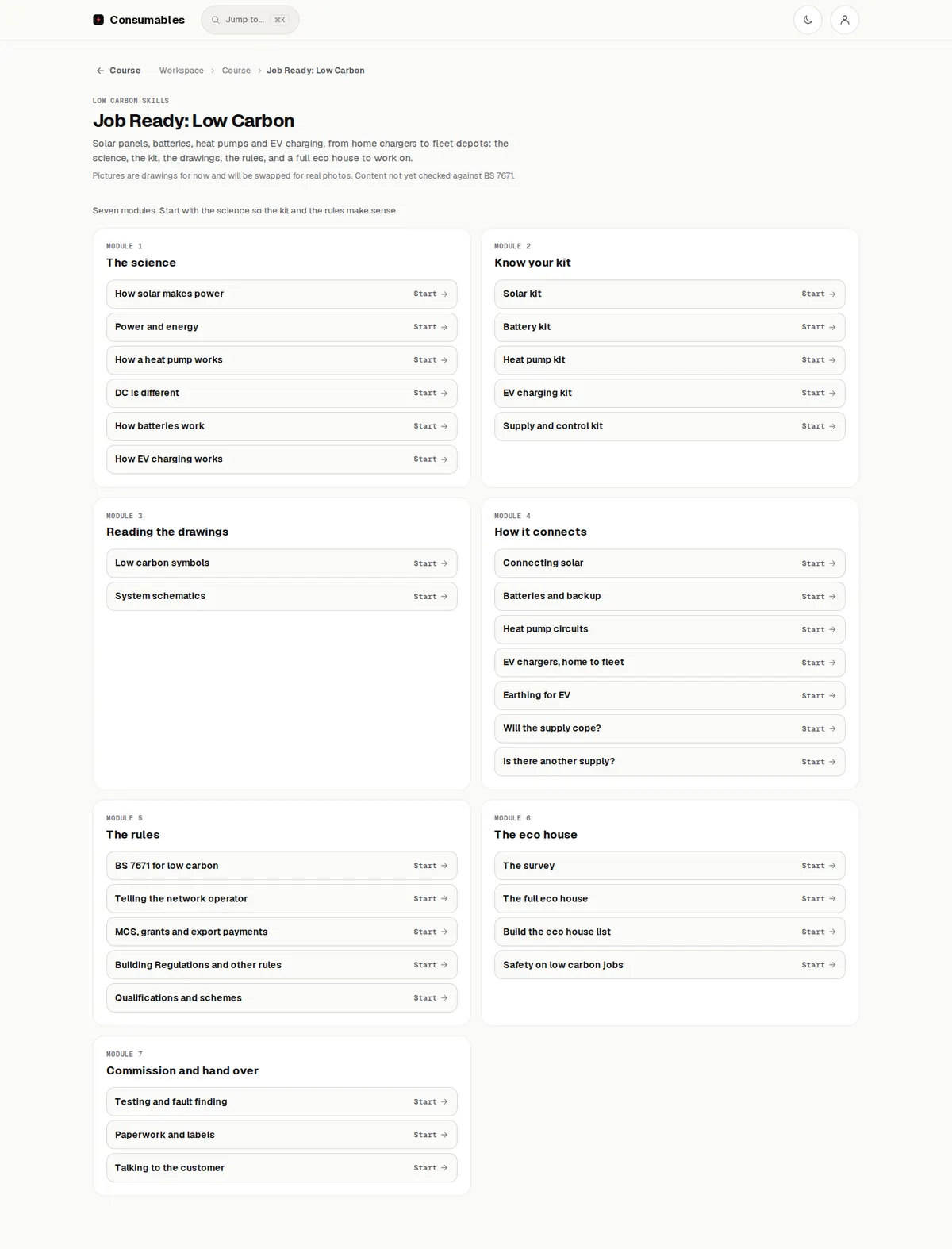
Solar PV, battery storage, heat pumps and EV charging are where electrical work is growing fastest. Job Ready: Low Carbon is a clear route into that work, from the science to handing a finished system over to the customer.
The course follows a real job: how each technology works, the kit, the drawings, how each system connects (including earthing for EV charge points), the rules and who to tell, then a full eco house to survey, plan, order and commission.
Each lesson uses the same hands-on activities as Job Ready: picture cards, matching, tracing circuits on wiring diagrams, spotting mistakes and checking yourself at the end. The drawings show real layouts, so you learn to read a solar, battery or heat pump drawing the way you'll see it on a job.
Modules and lessons
Module 1
The science
- How solar makes power
- Power and energy
- How a heat pump works
- DC is different
- How batteries work
- How EV charging works
Module 2
Know your kit
- Solar kit
- Battery kit
- Heat pump kit
- EV charging kit
- Supply and control kit
Module 3
Reading the drawings
- Low carbon symbols
- System schematics
Module 4
How it connects
- Connecting solar
- Batteries and backup
- Heat pump circuits
- EV chargers, home to fleet
- Earthing for EV
- Will the supply cope?
- Is there another supply?
Module 5
The rules
- BS 7671 for low carbon
- Telling the network operator
- MCS, grants and export payments
- Building Regulations and other rules
- Qualifications and schemes
Module 6
The eco house
- The survey
- The full eco house
- Build the eco house list
- Safety on low carbon jobs
Module 7
Commission and hand over
- Testing and fault finding
- Paperwork and labels
- Talking to the customer
How to use it
- 1Begin with the science, so you understand how solar cells, batteries, heat pumps and EV chargers work.
- 2Learn the kit and the drawings, then see how each system connects to the house and to the supply.
- 3Read the rules lessons, which show when each was written and last checked, and note who has to be told before and after the work.
- 4Finish with the eco house: survey it, plan it, order the materials and hand it over to the customer.
Try a sample question
What kind of current does a solar panel make?
- AAlternating current (AC)
- BThree-phase AC
- CDirect current (DC)
- DNo current until the inverter is on
Show the answer
Answer: C. Solar cells make DC. The inverter turns it into AC.
Questions about this course
- Does this course qualify me to install solar, batteries, heat pumps or EV chargers?
- No. It teaches the knowledge you need and points you to the qualifications that apply. You still need the right qualification and registration to do the work.
- Are the rules up to date?
- Rules for this work change often, so each rules lesson shows when it was written and when it was last checked, and reminds you to check the current edition of each document.
- Does it cover commercial EV charging?
- Yes. As well as home chargers, the EV lessons cover bigger supplies for 22 kW home charging and commercial and fleet charging, including how the supply and earthing are planned.
- How much does it cost?
- One subscription opens every course: £6.49 a month or £57 a year. Every new account starts with 14 days free, and you can cancel any time.
Start learning today
14 days free. Sign up with your email in a minute. Works on your phone, tablet and computer.