On-site skills
Job Ready
Know the kit, read the drawings and understand the paperwork, domestic and commercial.
Who it’s for
Apprentices and improvers who want to be useful on site from day one.
What’s inside
- Kit and tools: what it is, what it does, how to spot it
- Reading drawings: symbols, layouts, circuit diagrams
- Whole-house and commercial jobs: count it, order it, trace it
- Boards, certificates, test results and site paperwork
Why it helps
The things nobody has time to teach you on a busy job, learned with real-job activities.
College teaches the theory, but on site you're expected to know the kit, read the drawings and get on with the job. Job Ready fills that gap, for domestic and commercial work.
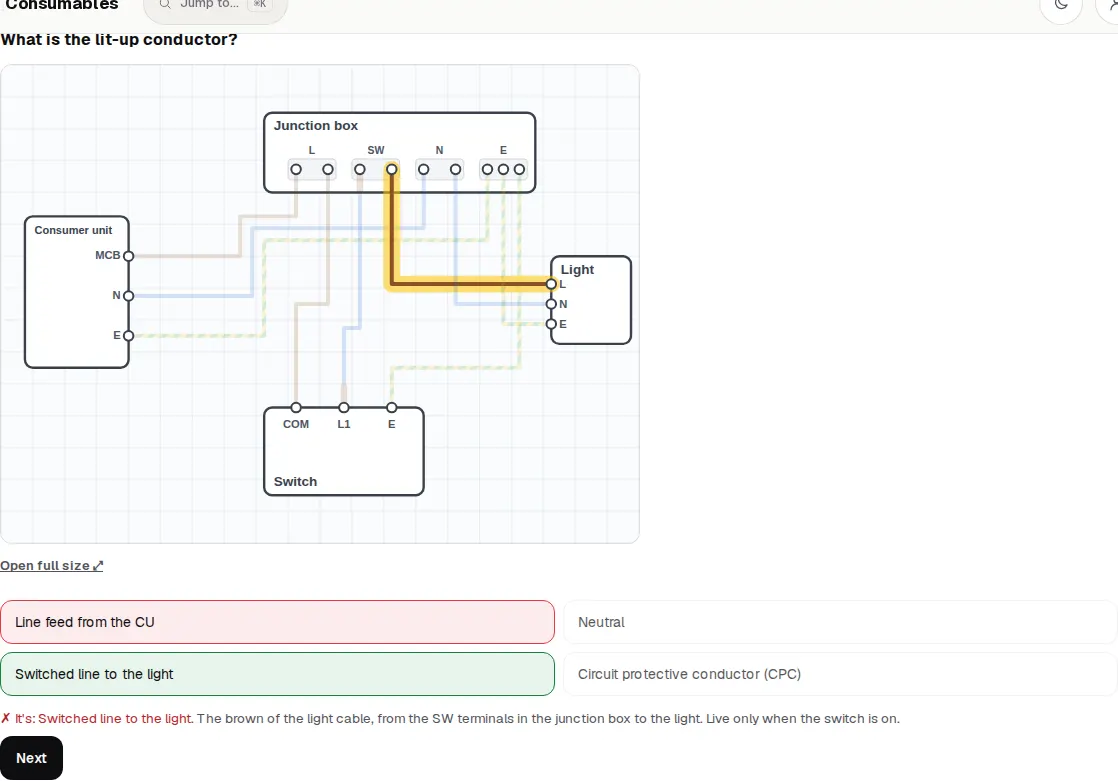
Each lesson starts with picture cards (what it is, what it does, how to spot it), then hands-on activities: what is this, match it, tap the part on a plan, trace the circuit, count and order the materials, spot the mistake, put the steps in order, sort it and wire it. Every lesson ends with a short check yourself quiz.
Modules and lessons
Domestic, Module 1
Know your kit
- Protective devices
- The supply and the consumer unit
- Accessories
- Cables and flex
- Boxes, containment and fixings
- Earthing and bonding
- Tools and test kit
Domestic, Module 2
Symbols
- Symbols on house drawings
- Symbols on circuit diagrams
Domestic, Module 3
Reading diagrams
- The four kinds of drawing
- Lighting circuits
- Power circuits
- Cookers, showers and other fixed loads
- First two-floor house
- Bigger house
- Family house
- Older house rewire
Domestic, Module 4
The board and its paperwork
- Reading a consumer unit
- Certificates
- Schedule of test results
Domestic, Module 5
First fix and second fix
- The stages of a job
- First fix: routes and safe zones
- First fix: boxes and cables in
- The first fix walk-round
- Second fix: terminations
- Second fix: fitting off and the board
- Before you switch on
- A whole job
Domestic, Module 6
On the job
- Materials from a drawing
- Job sheets, RAMS and handover
Commercial, Module 1
Know your kit
- What changes on commercial jobs
- Distribution gear
- Control gear
- Commercial accessories
- Commercial cables and glands
- Containment
- Commercial test kit and safety
Commercial, Module 2
Symbols
- Commercial symbols
Commercial, Module 3
Reading diagrams
- Distribution schematics
- Control circuits
- Emergency lighting and fire alarm drawings
Commercial, Module 4
The board and its paperwork
- Three-phase boards
- Three-phase certificates and results
Commercial, Module 5
First fix and second fix
- The stages of a commercial job
- First fix: containment
- First fix: SWA and glands
- Second fix: three-phase terminations
- Testing and energising a commercial job
Commercial, Module 6
On the job
- Construction drawings
- Containment and cable take-off
- Site paperwork
How to use it
- 1Start each lesson with its picture cards: what each item is, what it does and how to spot it on site.
- 2Work through the lesson's activities, from naming the kit to tracing circuits, counting materials and wiring accessories.
- 3Finish with the check yourself quiz. A lesson is complete when every activity and the quiz are passed.
- 4Use the domestic part first if you're new, then move on to the commercial part with its three-phase boards, containment and SWA.
Try a sample question
A cable is buried less than 50 mm deep in a wall. Where must it run?
- ADiagonally, by the shortest route
- BAnywhere, once the wall is plastered
- CIn a safe zone: within 150 mm of the top of the wall or a corner, or straight up, down or across to an accessory
- DOnly along the skirting
Show the answer
Answer: C. These are the safe zones, where people expect a cable and so avoid fixing into it. The cable also needs extra protection, such as 30 mA RCD protection.
Questions about this course
- Do I need to be on a course to use Job Ready?
- No. Job Ready suits apprentices, improvers and anyone starting out on site, whatever course they're on.
- Does it cover first fix and second fix?
- Yes. Module 5 covers routes and safe zones, boxes and cables, the walk-round, terminations, fitting off and getting ready to switch on, for houses and for commercial jobs.
- How much does it cost?
- One subscription opens every course: £6.49 a month or £57 a year. Every new account starts with 14 days free, and you can cancel any time.
Free guides
Read before you start
Start learning today
14 days free. Sign up with your email in a minute. Works on your phone, tablet and computer.